Paris is an art capital, a city of flowers, and above all a hub of European humanism. It is a highly open and integrated metropolis whose unique aesthetic, chic lifestyle, intellectual breadth, and spirit of freedom possess a captivating charm. To say that Paris belongs solely to France would be too narrow (even though it is the capital and the political and economic core); rather, it belongs to art and freedom lovers worldwide. As an art capital, Paris has long been the dream destination for artists (painters, sculptors, musicians, playwrights, and dancers), poets, writers, and literary figures from across the globe. It remains a breeding ground for artistic and literary creation, a haven for those who love freedom and romance, a sanctuary for exiled politicians and thinkers, a paradise for consumers, a global center for luxury goods, and a launchpad for world art trends and fashion.
Since the Renaissance, Paris has been the capital of France and the core of its politics and economy. Since the 17th century, under Louis XIV, the Sun King, Paris became the political center of Europe. The French style of luxurious living set an example for royalty and nobility across Europe, while Parisian intellectual currents shaped European trends and influenced the evolution of world civilization, establishing Paris as a great metropolis where European humanism converged.
In modern times, the areas where Parisian humanities and arts intersect have updated their spaces with changing eras. In the mid-19th century, the area around Montmartre’s Moulin Rouge featured Renoir’s “Moulin de la Galette,” Lautrec’s “Moulin Rouge Dancers,” and Van Gogh’s residence in Montmartre. By the early 20th century, Utrillo’s “Montmartre Landscapes” emerged, and even Picasso, one of the world’s most famous painters, lived in the “Bateau-Lavoir” artist village in Montmartre.
After World War I in the 20th century, the cultural hub shifted from Montmartre to Montparnasse. Today, when people discuss modern art, they think of the “École de Paris.” Notable painters include Chagall, Soutine, Modigliani, and the Japanese painter Fujita; sculptors Bourdelle and Zadkine also lived and worked in this area. The “École de Paris” is also known as the “Montmartre School” because these painters and sculptors settled in Montparnasse and frequently gathered at the famous “La Rotonde” café. Until World War II, Montparnasse remained the space where Parisian culture converged. Russian revolutionary leaders Trotsky and Lenin appeared in this café; Giacometti’s studio was nearby; and avant-garde groups, including Surrealists, used “La Rotonde” as a space for new ideas, sparking brilliance and innovation.
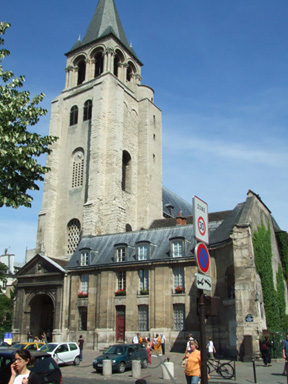
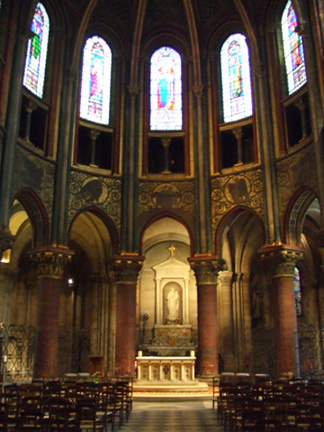
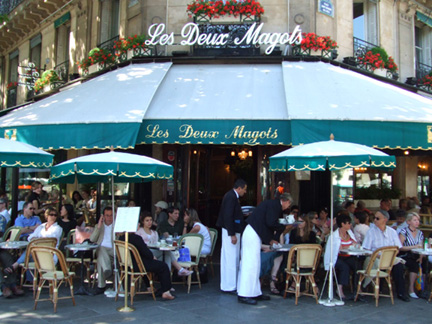
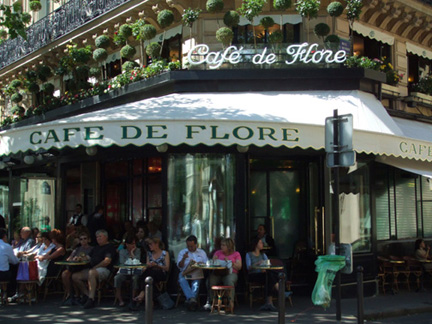
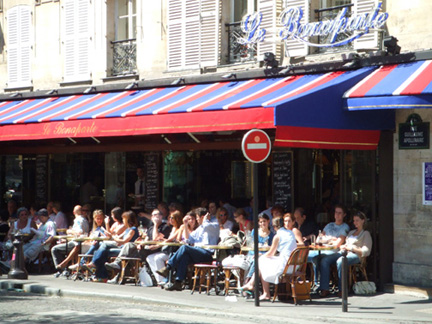
After World War II, humanity woke from the devastation of war. In a depressed society questioning existence itself, existentialist thought led by Sartre and de Beauvoir gained popularity, offering new perspectives on life and being. The war deeply changed France’s politics and economy; the rising power of the United States replaced aging Europe, and New York’s status in modern art surpassed Paris. Paris’s artistic and cultural landscape changed profoundly. As circumstances shifted, Montparnasse’s cultural beauty faded, and the emerging Latin Quarter’s Saint-Germain-des-Prés emitted new cultural light. New galleries concentrated around the École des Beaux-Arts in Saint-Germain-des-Prés. Countless bookstores, restaurants, bars, and cafés sprang up, becoming a gathering place for the Parisian middle class, writers, singers, bohemian artists, trendsetters, and art lovers to debate passionately. It became the core of Paris nightlife and new trends. In such a cultural environment, restaurants, bars, and cafés were always full. The convergence of new ideas took place at Café Les Deux Magots and Café de Flore, centered around the Saint-Germain-des-Prés church, where philosophers Sartre and de Beauvoir popularized existentialism through lively debates. Saint-Germain-des-Prés has been the cultural hub of Paris since World War II, leaving unforgettable memories and becoming a must-visit site for cultural tourism today.