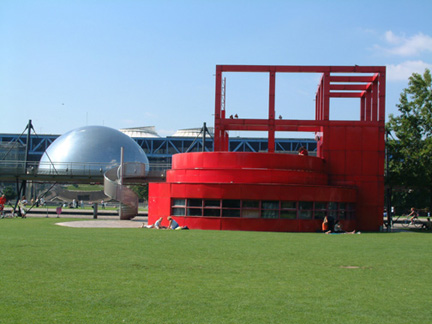
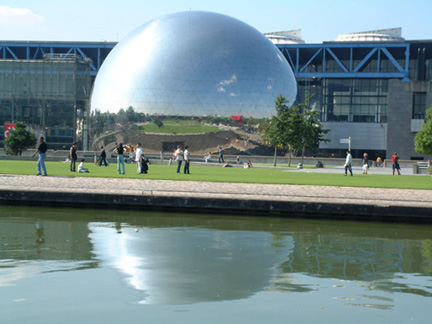
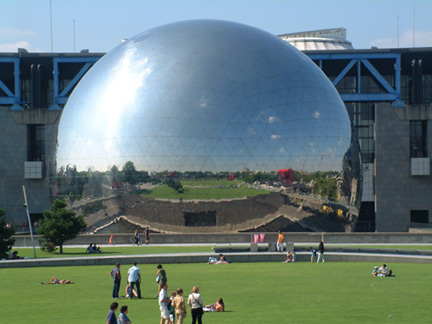
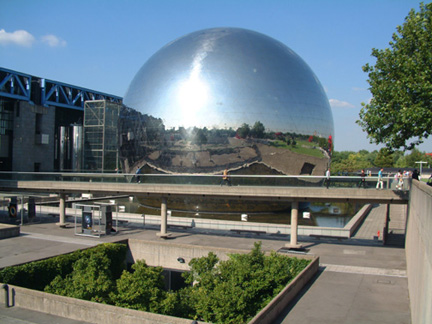
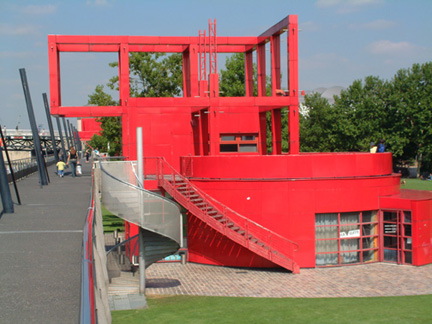
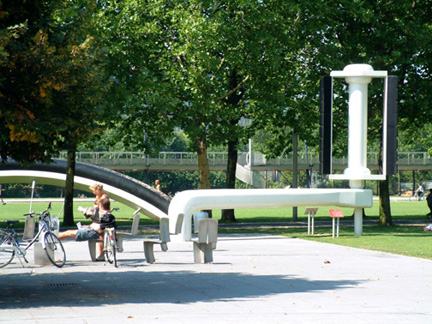
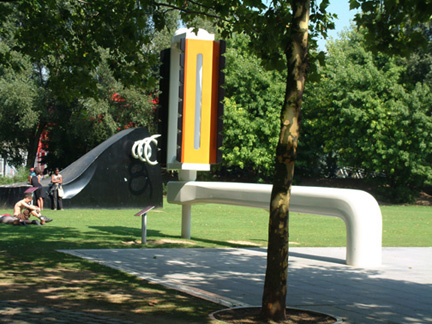
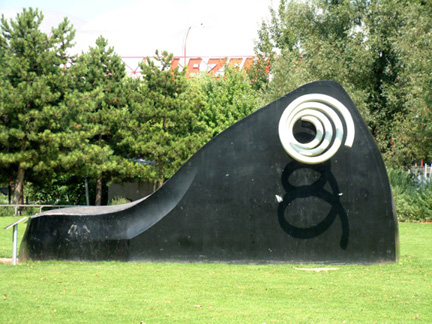
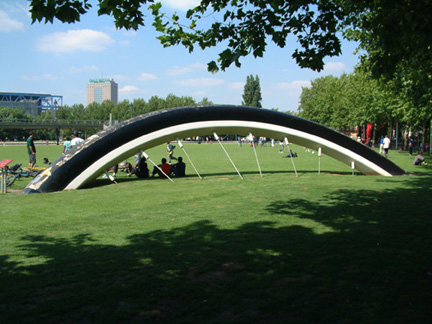
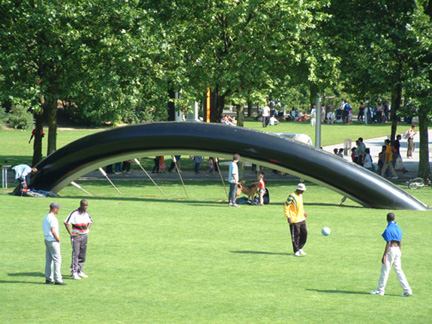
is the most exemplary landscape of Western postmodernism. It is neither a traditional French garden nor a naturally formed English garden. It is neither classical nor modern. Rather, it is a postmodern (or hypermodern) garden — some say it is a garden of the twenty-first century. Within its superbly perfect futurist forms, there are hardly any flowers or plants, let alone lush dense woods, yet it possesses a vast open green space. This is precisely one of the greatest characteristics of postmodern gardens, creating a multifunctional recreational space within the city (for example, outdoor concerts, films, circuses, sports, leisurely strolls, and all kinds of exhibitions, and so on).
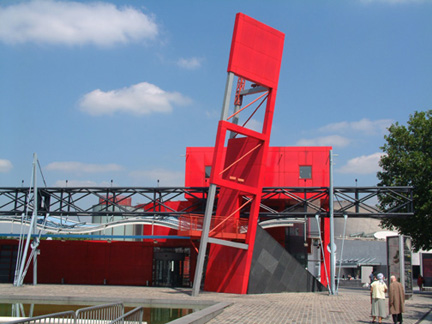
The entire park, within its perfectly geometric streamlined architectural forms, presents a very concrete yet abstract — but also very concrete — structure of points, lines, and planes. Like avant-garde visual art, it is full of imaginative forms and substantive space, pleasing to the eye, and has become an excellent spot for Parisians to relax and enjoy themselves. This Parc de la Villette, full of grandeur and charm, is the masterpiece of the renowned landscape architect Bernard Tschumi, created as part of the urban renewal plan for the northern district of Paris in the nineties.
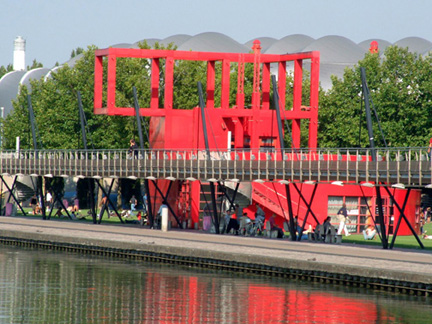
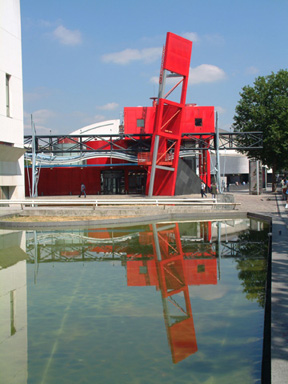
The expansive park (35 hectares) is sandwiched between hypermodern buildings such as the petrochemical-plant-like Cité des Sciences et de l'Industrie (museum), the spectacular crystal glass sphere (Geode), the gracefully curving Cité de la Musique (museum and concert hall), the music conservatory, the wave-roofed Grand Halle (large theater), and the iron-frame glass market exhibition hall, with the poetic Ourcq Canal, shimmering with watery reflections, running through it. These unconventional buildings serve as an excellent backdrop for Parc de la Villette, blending into the park's grand landscape.
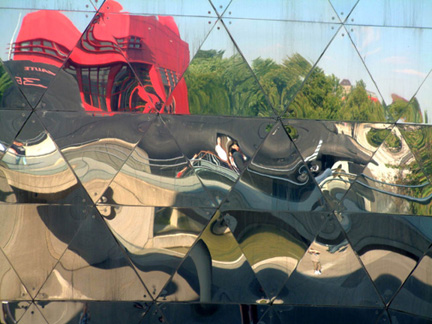
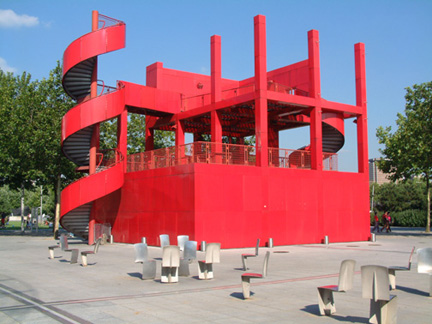
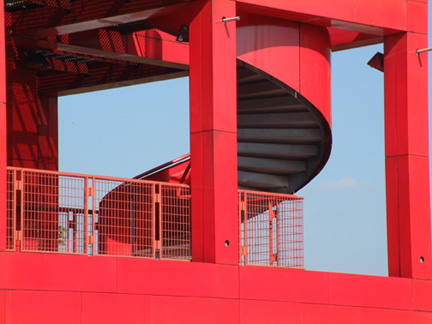
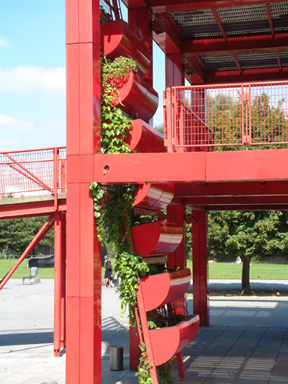
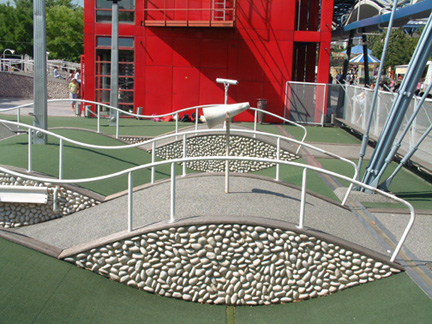
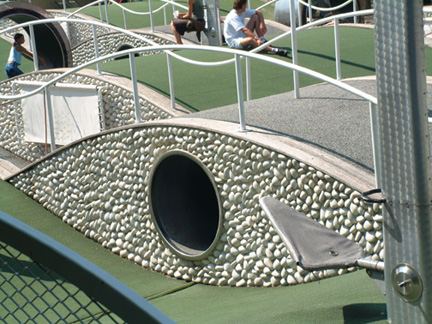
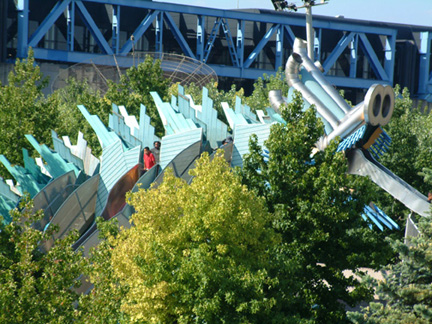
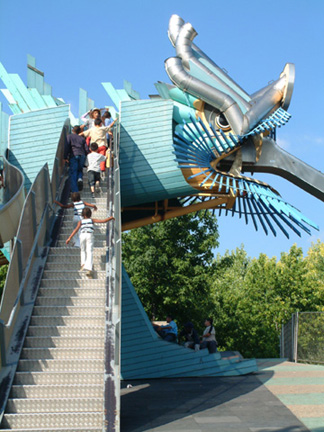
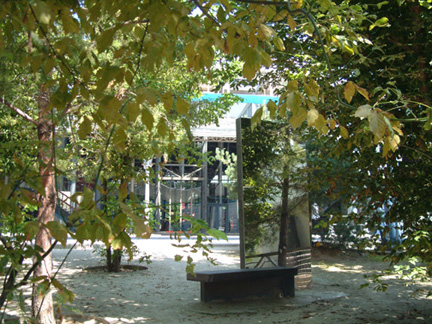
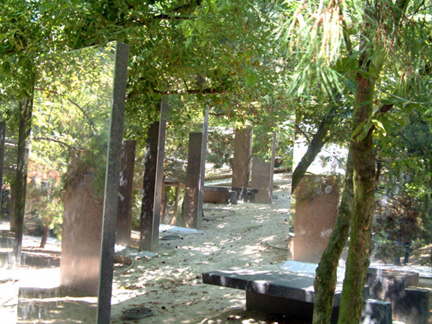
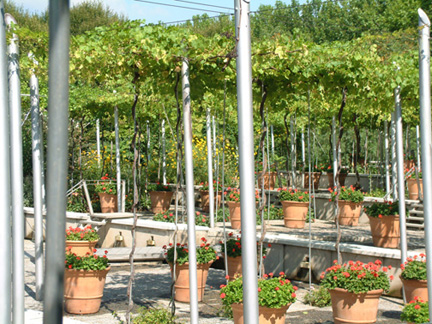
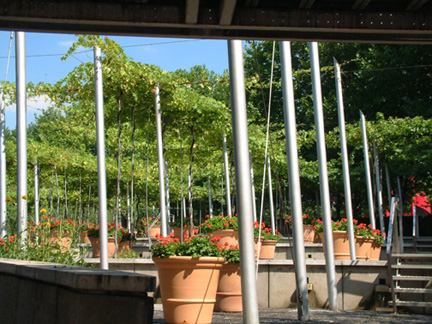
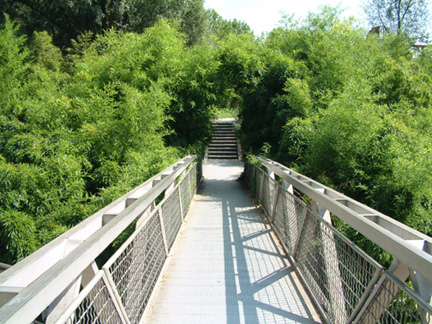
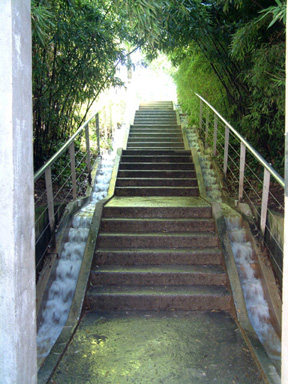
Vijet Park is a paradigm of new-century gardens and a masterpiece of the 1990s Huadu North District urban renewal plan, situated between the Industrial City and Music City.Vijet Park, with its spectacular industrial city and crystal glass ball as an outstanding backdrop, is traversed by the shimmering waters of the Ukok Canal.The crystal glass spheres subtly form one of the spectacular and grand landscapes of Vihet Park.The magnificent vista of the Viet Industrial Science City has become the most modern urban landscape in the northern part of the city.A park reflected in a crystal glass ball, full of imaginative space and scenic beauty.Vilette Park is centered on bright red structural buildings scattered throughout every corner of the park, as if they were objects or themes within the park.The entire park, within its perfectly geometric and fluid architectural forms, manifests highly concrete concepts and equally tangible structures.The vivid red structural building features solid and void elements, monuments, waterfalls, observation decks, and other components that are conceptual, structural, and visually striking.The flying corridors and aerial walkways are continuously constructed along the banks of the Ukok Canal, forming a distinctive landscape with bright red buildings.Is the bright red structure a building or a massive sculpture? There are 25 in total; this is a close-up of one.The vibrant, horizontally striped building integrates seamlessly with the natural greenery, creating a harmonious visual effect.No one would mistake this scene for a park, as natural architecture has been replaced by the architecture of nature.The modernized garden features seven wonderful children's playgrounds, serving as a paradise for urban toddlers and children.The gardens include Fengyuan, Wuyuan, Pingheng Yuan, Jingxia Yuan, Longyuan, and others. Diversity and openness are their greatest features.The Dragon Garden, with its massive slide, was the most captivating attraction for children in the Children's Paradise, keeping them so engrossed that they forgot to go home.The rhythmic dragon slide attracts many urban children on weekends, who linger happily.The garden features three uniquely wonderful wandering gardens, among which the Mirror Garden's labyrinth is the most bewildering.The Mirror Garden of the Maze reflects and refracts, creating a space full of whimsical imagination between illusion and reality.The vineyard in the garden serves as a shaded area and a summer retreat, located along the expansive trellises bordering the large lawn.Large potted plantings of small shrubs from the Under the Vineyard series, surrounded by murmuring streams, evoking natural imagery.Seasonal potted flowers and plants in full bloom under the vineyard, equipped with state-of-the-art automatic irrigation systems.Opposite the vineyard lies a poetic bamboo garden, planted in an open-air basement with an elevated iron walkway spanning above it.Entering the bamboo garden through a lush bamboo fence, cascading waterfalls flank the stairs on both sides, leading to an enchanting circular wall that emits clear, melodious music.The geometric bamboo garden is composed of bamboos of various heights and thicknesses. A large energy wall beside it emits moisture and heat, creating a subtropical climate environment.Among the diverse parks, there is also the most dramatic public landscape art,in the circular along both sides of the prairie tree-lined path,C Oldenburgmasterpiece。Oh! What is this? Isn't this an upside-down bicycle pedal, so enormous that it confounds our accustomed visual image, thereby becoming magical.What about this? The half-exposed car body, with its stark black-and-white contrast, is quite humorous and abstract; only upon closer inspection does one realize how realistic it is.Ah, isn't this a bicycle tire two-thirds buried in the ground, blending humor and wit, abstraction and realism, imagination and limitation?These monumental landscape sculptures became the largest children's toys in Huadu.