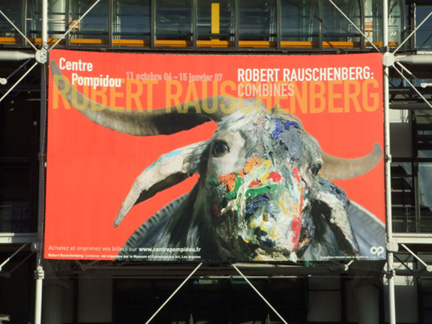
"Rauschenberg: Combines" was exhibited from October 15, 2006, to January 15, 2007, in the large exhibition hall on the sixth floor of the Centre Pompidou. This was Paris's first grand and comprehensive exhibition dedicated to this most representative American artist of the 1960s, bringing a climax to the art world in the second half of 2006.
Born in Texas in 1925, Rauschenberg is a master of post-war American Neo-Dadaism and Assemblage Art, as well as a pioneer of American Pop Art. His works are filled with mundane subjects, blending them with a self-mocking attitude into his highly creative expressions and poetry. Clearly, Rauschenberg never stayed within a single stylistic mode; consequently, formalist artists of the 1960s were very critical of him, believing his work represented all the flaws of modernists: frivolity, diversity, self-absorption, impurity, and lack of seriousness. Conversely, they were stimulated by his bold, abundant, and unpretentious talent. For him, art could exist for any length of time, on any object (from goat specimens to living human bodies), in any place (not just on stage, before video cameras, underwater, on the moon, or in sealed envelopes), for any purpose (to please, contemplate, meditate, entertain, stimulate, or frighten), and in any exhibition venue—from museums to trash cans. As he himself declared: "Why not admit that the world is a combined painting!"
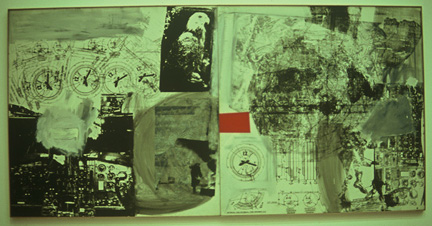
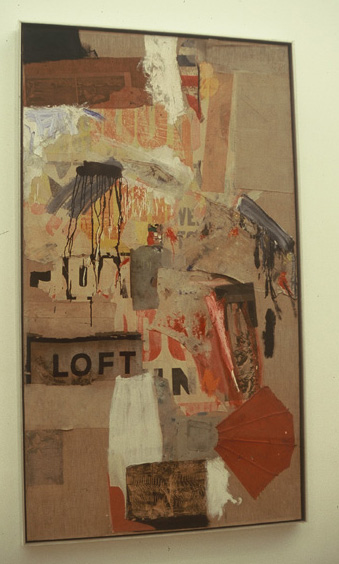
After exhibiting monochrome paintings for the first time in 1950, Rauschenberg quickly turned to exploring Combined Paintings, a new form of creation where various images and objects are synthesized onto the surface of the painting (silkscreen) like collage. Clearly influenced by Dadaist artist Kurt Schwitters, he often loosely linked a series of images with similar attributes to form themes. In works like "Paint Puzzle," the dominant theme is flight, so the pictures include photos of bees, dragonflies, mosquitoes, and fly eyes, cleverly combined with Botticelli's "The Birth of Venus." He explained this work twenty years later: "I tried to use something very abstract so that others couldn't tell what it was, or the tangled (overlapping image) objects so that people couldn't recognize them. When you look closely, they are obvious things that no one had ever thought to use."
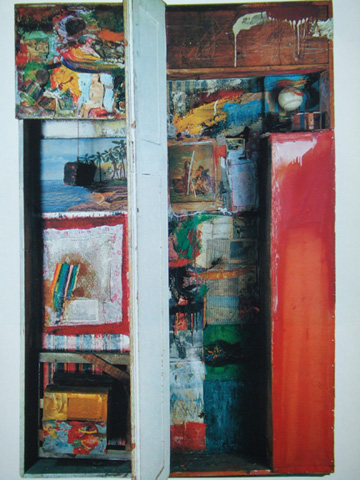
Through the development of these combined paintings, Rauschenberg evolved into three-dimensional object paintings. He added found objects to his combined paintings, creating works that were both paintings and sculptures, thus breaking the traditional boundaries of painting and sculpture. For example, "Odalisk" (completed between 1955 and 1958) reminds one of Ingres's nude women in their boudoirs through its title. A column stands on a soft pillow, with a box covered in prints of classical nudes on top. A veil wraps around the box, metaphorically representing the veil worn by Muslim women. On top of the box stands a specimen of a chicken, reaching from heaven to earth—isn't this how the French describe high-class prostitutes as luxurious hens? The completed "Canyon" in 1959, featuring a mounted eagle with spread wings, and "Monogram," both became object paintings and three-dimensional works, centered poetically on a goat hanging an automobile tire. These clearly exist between painting and sculpture, flatness and volume, painting and object.
Assemblage Art is the precursor to Pop Art. In 1961, the Museum of Modern Art in New York held a major exhibition titled "Assemblage Art." Critic William C. Seitz wrote in the preface to the exhibition catalog: "The current trend of Assemblage Art marks a shift from subjective, fluid abstract art to a combined art recalibrated with the environment. This technique of juxtaposing objects is a very appropriate method for losing the charm of the simple international vocabulary of abstract art, which has become loose and powerless, and for reflecting the social values revealed by this situation."
Assemblage Art not only provided a means to transform Abstract Expressionism into Pop Art, which has quite different premises, but also caused artists to fundamentally rethink the forms possible in visual arts. For instance, Assemblage Art provided a starting point for two concepts that have increasingly shown their importance to artists: Environmental Art and Happening.
(Reference: Post-WWII Visual Arts, pp. 121-122, by Lucy Lippard, translated by Li Chang-jun, published by Dalu Bookstore in 1974)