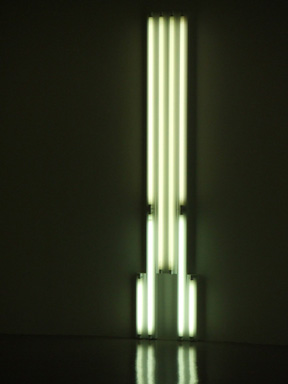
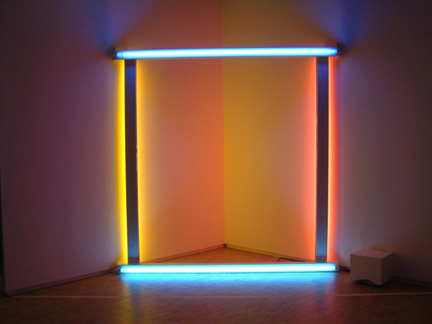
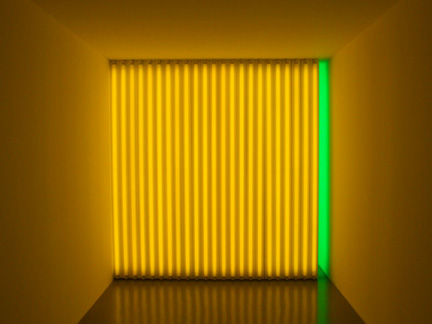
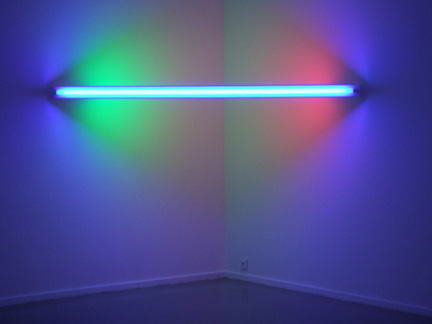
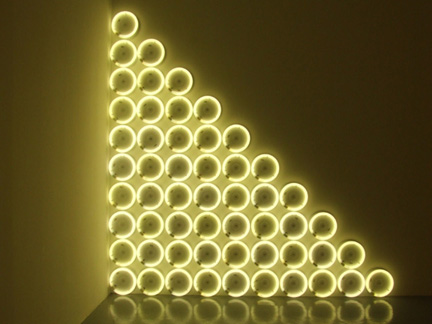
The "Dan Flavin Retrospective" was exhibited at the Musée Municipal d'Art Moderne de la Ville de Paris from June 9 to October 8, 2006. It offered a clear overview of Flavin's unique artistic creation throughout his life, ranging from the "Icon" series starting in 1961 to the grand "Tallinn Monument" series (1964–1982), leading into a poetic and imaginative world through mesmerizing halos (colors), architectural and mathematical forms, material and immaterial elements, and extraordinary spaces.
Dan Flavin (1933–1996) was one of the most representative artists of American Minimalism. After graduating with a degree in art history from Columbia University in New York in 1959, he began his artistic career, initially influenced by Abstract Expressionism and Pop Art. In 1961, he completed his first light work, adding a series of bulbs or fluorescent tubes around monochrome paintings. The following year, his most characteristic "Icon" series consisted of a single fluorescent tube combined with a frosted panel. It was not until 1964 that Flavin exclusively adopted industrial neon tubes to construct his works according to space, as the illuminated halo of industrial neon tubes realized an idealized sculpture while possessing exceptional expressiveness. Through fluorescent tubes, he realized that this infinite halo resolved formal issues, providing environmental spatial organization beginning with light. The artist stated: "I have successfully channeled all the anxieties of artistic work; for me, the task is complete, now it is up to electricians or engineers..." These industrial tubes ranged from 60 to 250 cm in length, sometimes displayed alone according to the spatial context, such as "Homage to Jones" (1963), which featured a pink neon tube placed in a corner. Subsequently, various sizes of tubes were combined, as seen in the famous "Tallinn Monument" series (1964–1982). The works relied on logical, mathematical thinking and simple geometric construction forms because the tubes were not merely material but also form, light, and color. Of course, the materials he considered included not just light but the overall spatial construction. In 1966, Flavin wrote: "I know that exhibition space can be destroyed; through constructed illusion, the neon painted halo will be managed as I wish," and added: "I know I can manage and reveal true space through the careful combination of tubes." Later, in the work "Alternating Pink and Yellow_to Joseph Halmy," supports were completely abandoned, and the entire space emitted a mesmerizing white and golden halo, integrating the environment so that his art approached an immaterial world, existing within a poetic imaginative space, forming an environmental art. The artist said: "Without tactile material, simply viewing the light is enough to fascinate people."