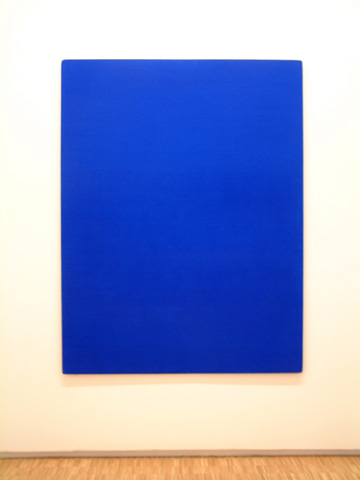
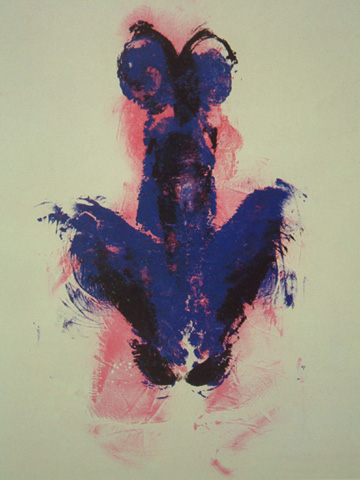
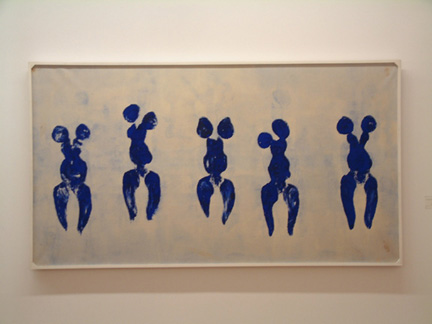
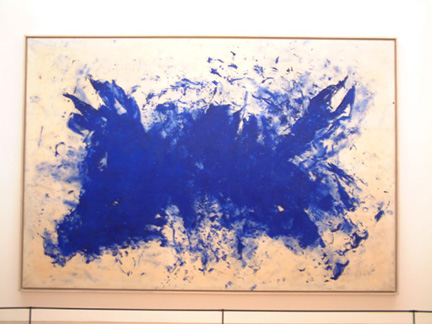
"Klein: Body, Color, Immaterial" (Yves Klein: Corps, Couleur, Immateriel) was exhibited from October 5, 2006, to February 5, 2007, in the Grand Exhibition Hall on the sixth floor of the Centre Pompidou. It was the most spectacular and grand exhibition of the second half of 2006 at the Paris Centre Pompidou (along with Rosenberg).
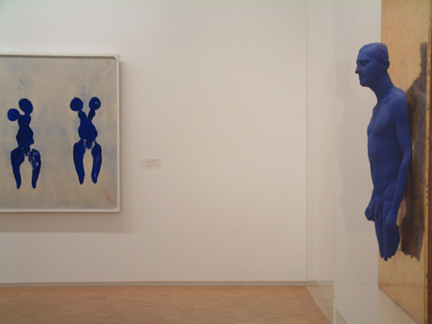
Klein (1928–1962) was the most avant-garde and mysterious artist among the French New Realists (Nouveaux Réalistes) of the 1960s. Beginning his exploration of monochrome painting in the 1950s, deep blue became the core of his work two years later; he called this International Klein Blue (IKB), infinitely expanding the mysterious world of materialized deep blue. The artist wrote, "Regarding color, I am fully aware of it and regard it as emotion and space, so I am indeed free and unbound." Soon Klein arrived at the other side of the utopian world, attempting to explore the "empty" and the "immaterial." In 1958, he first exhibited the "Empty" show before an audience at the Iris Clert Gallery. Two thousand people attended the opening reception facing a gallery containing nothing; his works appeared conceptual, like a new synthesis of contemporary reality. More avant-gardely, on March 9, 1960, during the creation of "Anthropometry" at the Galerie de France in Paris, nude female models served as living brushes. Under Pierre Henry's direction conducting Klein's "Monotone Symphony," women coated in thick deep blue paint pressed their pigments onto large white canvases (like a performance). Here, the element of painting continued to exist, but it no longer held its dominant position. Craftsmanship was reduced, and the concept of painting created a gap, because Klein wore a suit, bow tie, and white gloves, not touching any paint himself. People in this diverse space demonstrated that action performance equated entirely to painting, concerts, and theater concepts. Such works thoroughly updated plastic arts, reaching a peak alongside what people in the late 1960s called "Conceptual Art," "Body Art," or "Corporeal Art."
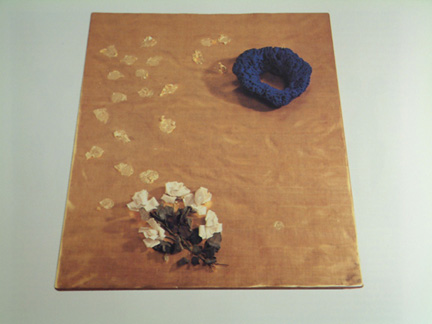
In February 1960, Klein held a solo exhibition at the Musée des Arts Décoratifs in Paris, first exhibiting Monogold (gold leaf applied to canvas), along with architectural plans for air and Cosmogonies using natural elements like wind, rain, and lightning. He also participated in group exhibitions by the New Realists in Paris and Milan. The following year, at the Gaz de France testing facility, he created "Sculpture of Fire" using gas, then attempted "Paintings of Fire" through fire-based anthropometric tests. In 1962, he reproduced Arman's statue, then coated it in copper lacquer and deep blue, displaying it on gold-leaf panels as "The End of Painting." For Klein, the artist is completely free; life exists in that state which is color itself, atmosphere, or gesture, no longer considering material supports but avoiding completion through circulating ideas. Klein repeatedly emphasized: "I am a painter, people say I am a painter, and I myself believe I am indeed a painter, because I do not paint, or at least on the surface, but make my existence like a painting made by a painter, because at least in this era it is a more remarkable method."
The core of Klein's art explores body, color, and immateriality, targeting two directions: First, pure intellectual speculation, proposing a conceptual artistic foundation with strong mystical colors, affirming the transformation of immaterial sensitive areas. Second, appropriating those elements—human bodies and the Anthropometry series, even fire, wind, and rain converging into such cosmogonic foundations.