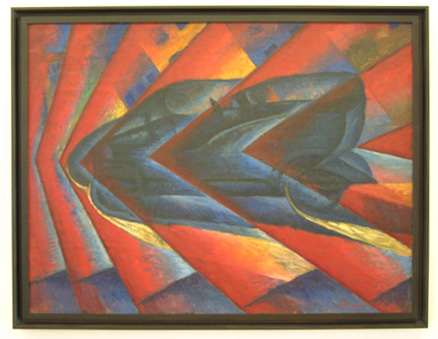
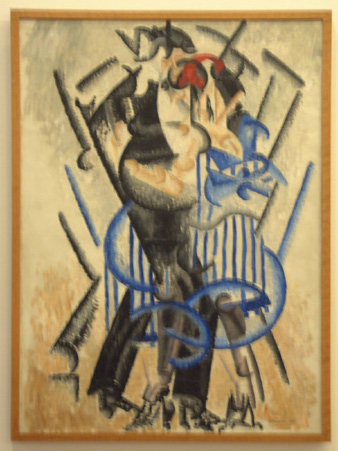
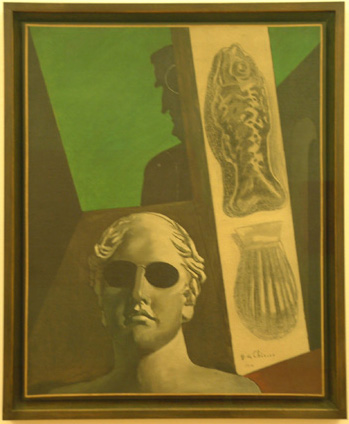
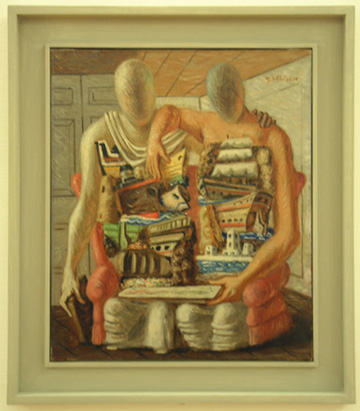
The special exhibition "An Adventure of Italian Art in the First Half of the 20th Century" (Une aventure de l art Italien 1900-1950) was held from April 5 to July 3, 2006, at the Grand Palais National Gallery. This was Paris's first systematic presentation of a panoramic view of Italian art from the first half of the 20th century. It was a grand exhibition featuring approximately one hundred works, including paintings and sculptures, sourced from numerous modern and contemporary Italian museums.
Mentioning 20th-century Italian art immediately brings Futurism to mind. In 1909, the poet Marinetti published a manifesto declaring the death of past art, the birth of Futurism, and the arrival of a new aesthetic standard. He argued that "a racing car is more beautiful than the Victory of Samothrace." The following year, a group of painters—Boccioni, Carrà, Russolo, Balla, and Severi—jointly issued the Manifesto of Futurist Painters: "Everything is in motion, constantly changing. The outlines of things are not static in our eyes but continuously appear and disappear, disappearing and appearing. Moving objects multiply in our vision and chase each other, trembling violently in their space of movement. A running horse has twenty legs, not four, and its leg movements form triangles." Here, a new absolute speed, a new vision of modern life, and a new cause—technology—were proclaimed. Driven by optimistic progress, Futurists emphasized the dynamics of modern life: using Divisionist (Neo-Impressionist) techniques under the influence of Cubism regarding form, rhythm, color, and light, they expressed an optimistic feeling, a state of simultaneity, and the diverse structures of the visible world. Futurist experience foreshadowed the arrival of Dada, Surrealism, and Happenings in the 1970s.
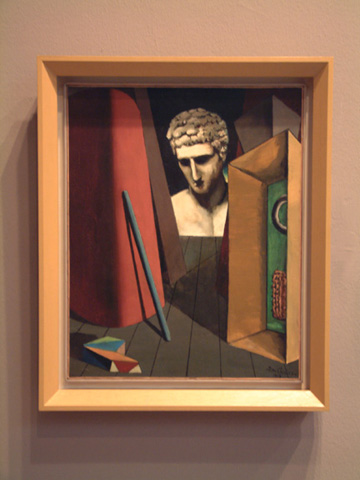
In the 1920s, Giorgio de Chirico (1888–1978) pioneered Metaphysical painting with his "Return to Rules," emphasizing a powerful sense of myth in his strong images. This became a magical visual force, exerting a bewitching and lasting influence as a precursor to Surrealism. During this period, another distinctly Italian painter, Morandi (1890–1964), returned to traditional painting. Starting in 1920, he affirmed painting within the still-life world of bottles and jars, exploring the "lost time" inwardly through form, color, light, shadow, tranquility, and poetry. De Chirico’s metaphysical painting, Carrà’s Primitivism, and Morandi’s return to painting deeply influenced the Transavanguardia art of the 1980s.
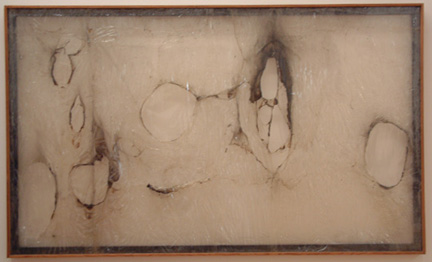
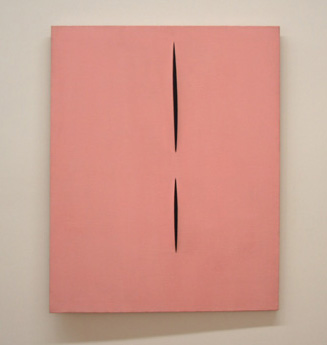
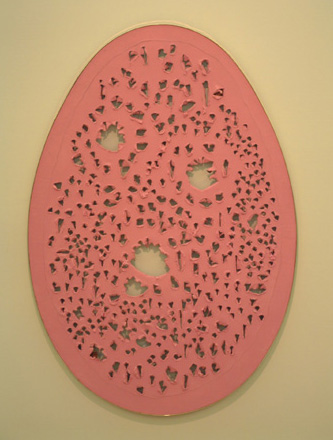
In the 1950s, the works of Alberto Burri (1915) and Lucio Fontana (1899–1968) became incarnations of radical reform in Italian art, manifested through metaphor and aesthetics. Fontana’s entire oeuvre revolved around the concept of space; he issued a series of Spazialismo (Spatialism) statements, reusing scientific and evolutionary themes developed by the Futurists since 1909 within a lyrical form. Under intense material forms, he presented time and space, celestial and geological, imagination and magic; the concept of "Spatialism" became the main subject of his work. Burri affirmed the most ordinary and poorest materials of daily life—sand, stone, dirt, tattered cloth, burnt wood chips, raw iron sheets, scorched plastic, etc.—sensitively affirming the wounded body of painting. He emphasized the energy and tension of matter, displaying it directly between material and texture, form and color, physics and psychology, symbol and metaphor, becoming a pioneer in the exploration of Italian Material Art. Both Burri and Fontana paved the way for Arte Povera in Italy in the late 1960s.