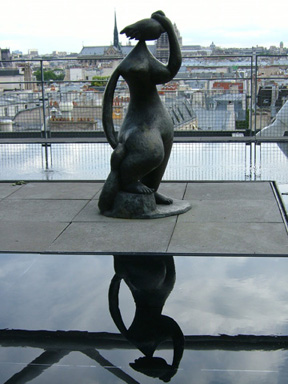
Address: Place-Georges Pompidou Rue Beaubourg 75004 Paris
Phone: 44 78 12 33
Metro: Line 1 Hotel de Ville Station, Line 11 Rambuteau Station
Line 1, Line 4, RER A and B Chatelet Les Halles Station
Opening Hours: 12:0022:00, Weekends 10:0022:00
Closed: Every Tuesday
(Free on the first Sunday of each month)
Visit Duration: About 3 hours
Website: Centre Pompidou www.centrepompidou.fr
Origin and Features of Centre Pompidou
This building resembling an oil refinery, Centre Pompidou, was established as a construction plan by French President Pompidou in 1969. In 1971, an international competition was held, with outstanding architectural design works from 44 countries and 681 participants. One work by three young architects... two Italian architects: Renzo Piano, Gianfranco Franchini, and one British architect Richard Rogers, etc., was selected. Construction began the following year (1972), and after nearly five years, it opened on January 31, 1977.
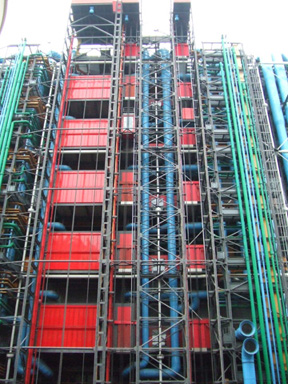
Centre Pompidou is 42 meters high, 166 meters long, and 60 meters wide, with 10 floors in total: 5 above ground, 2 entrances/exits, and 3 basement levels. Each floor has 7,500 square meters (about the size of two football fields), glass window area is 11,000 square meters, steel weight is 75,000 tons, total area is 103,300 square meters, underground parking has 700 spaces, and over 8 million people visit annually. Centre Pompidou is composed of four colors --- blue: air conditioning, green: water pipes, yellow: electrical conduits, red: elevators, etc.
Centre Pompidou is divided into four main units
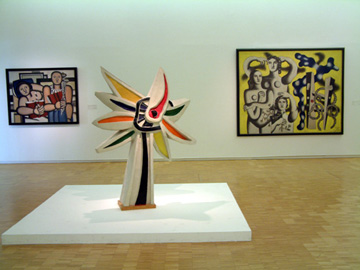
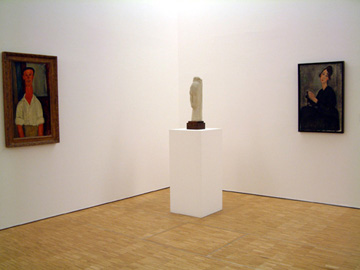
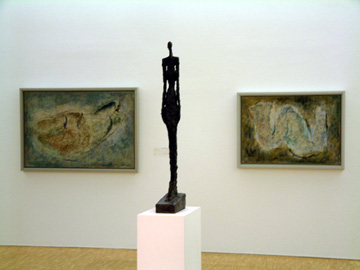
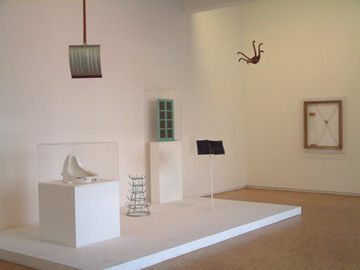
The National Museum of Modern Art (Musee Nationale d'Art Moderne, abbreviated MNAM) is on the 3rd and 4th floors. Here are collected the most complete and abundant artworks of the 20th century, inheriting the rich collections of previous modern art museums. The 4th floor is for permanent collection of modern art, and the 3rd floor is for regular collection of contemporary art, changing every two months. Today the museum collects 31,000 works, including 4,800 paintings, 2,800 sculptures, 13,900 drawings, and 6,600 photographs, and at least 2,000 new works are collected annually. Currently, due to lack of sufficient space, only 850 works are exhibited (Centre Pompidou is being re-planned to expand the museum to all spaces on the 5th floor).
MNAM includes the large gallery on the 5th floor --- specializing in hosting large thematic exhibitions, such as Paris-New York, Paris-Berlin, Paris-Paris, Viennese Modern Art, Japanese Avant-Garde Art, Modern Sculpture, etc., and retrospectives (Duchamp, Malevich, Pollock, Klein, Tinguely, Beuys, Chagall, Brancusi, etc.). On the plaza in front of the entrance to the drawing hall on the right side of the 4th-floor museum, drawings are exclusively exhibited. Below, the western contemporary gallery specializes in contemporary art (thematic exhibitions and various exhibitions), and the plaza in front of the lobby sometimes also becomes a space for contemporary art exhibitions. Of course, it also includes Brancusi's studio on the left side of the Centre Pompidou plaza.
The Industrial Design Center (Centre de Creation Industrielle, abbreviated CCI) includes the information center downstairs, Breves on the north side of the 1st floor, and the CCI gallery (specializing in industrial design and architecture) and the plaza in front of the main entrance on the 5th floor and downstairs, which are shared with the National Museum of Modern Art.
The Public Information Library (La Bibliotheque d'Information, abbreviated BPI) includes the news and current affairs room on the left downstairs, the youth news and current affairs room and library on the north side of the plaza downstairs; 1st, 2nd, and 3rd floors, accessible from the 2nd floor. The library houses 400,000 books in various languages, themes, and aspects, 150,000 slides, 14,000 records, video tapes, CDs, and CDVs (including music videos and data), 2,000 films, 250 software programs, 58,000 microfilms (about out-of-print books and collected books), and 2,000 microfilm reels (news newspapers and out-of-print magazines), 110 kinds of foreign languages (600 learning methods, 600 pronunciation materials, 140 foreign films, 16 foreign radio stations), 30,000 biographical materials (painters, philosophers, writers, etc.), and 250 thematic materials in a document bank on the 1st floor.
The Institute for Research and Coordination in Acoustics-Music (l'Institut de Recherche et de Coordination Acoustique-Musique, abbreviated IRCAM) is located in the basement of the Stravinsky Fountain, accessible from the adjacent building. This place specializes in exploring contemporary music, presided over by contemporary musician Pierre Boulez.
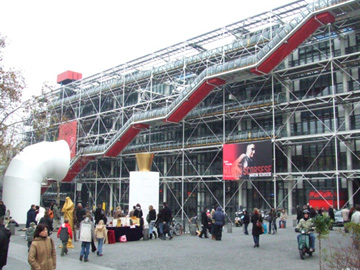
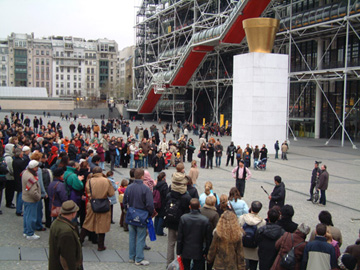
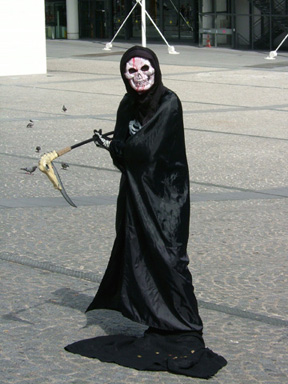
The Centre Pompidou plaza is the most open place in Paris, where wonderful performances always attract crowds of onlookers. There are various engaging performances on the plaza, from acrobatics, solo singing, playing instruments, mime, magic, singing guitar, storytelling, or funny comedy, etc., becoming a pilgrimage site for Paris tourists.
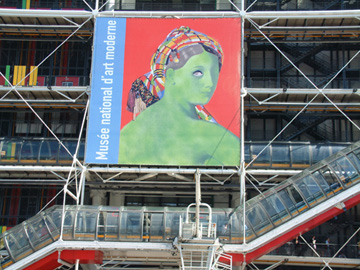
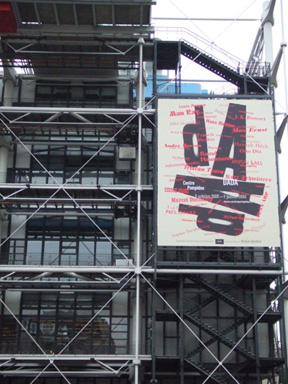
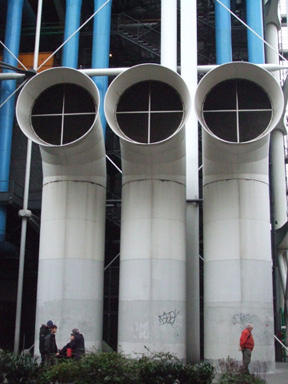
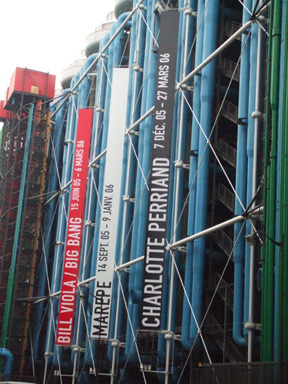
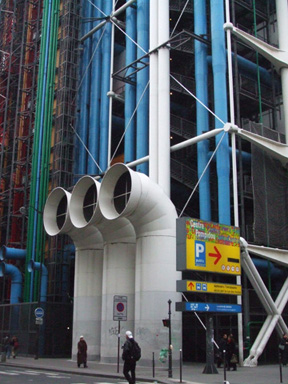
Left: In the Centre Pompidou plaza or behind, people see series of pipes like large chimneys that arouse curiosity, making one feel as if in a petrochemical factory; these are ventilation pipes inside the museum. Right: After seeing the front, looking at the back near the road makes it look even more like a petrochemical factory. It is composed of a series of large red and dark blue pipes forming the facade, with exhibition advertisements for this period hanging above.
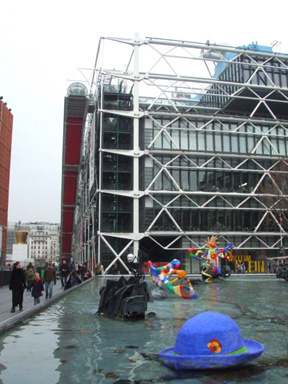
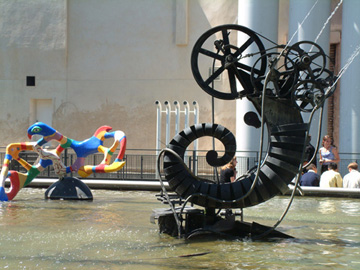
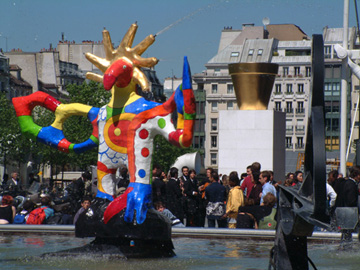
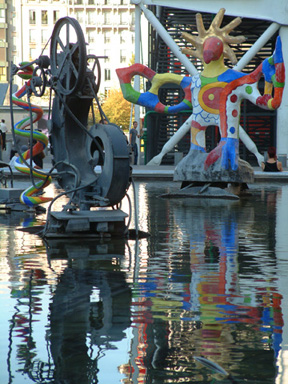
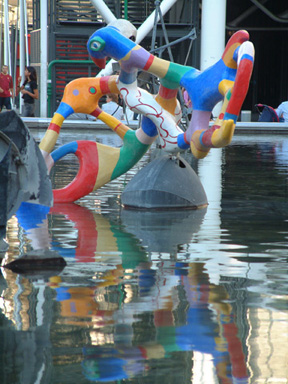
On the south plaza of Centre Pompidou stands a humorous and colorful fountain of Igor Stravinsky, a masterpiece by the famous couple artists Jean Tinguely and Niki de Saint Phalle.
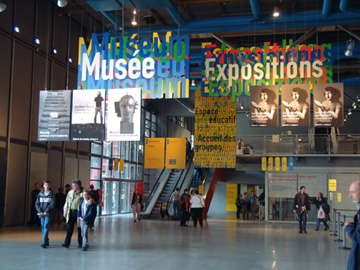
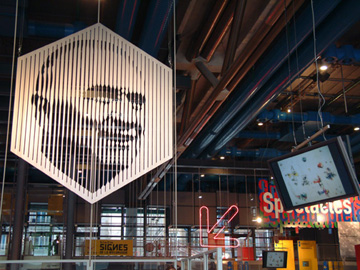
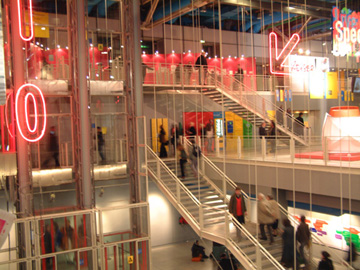
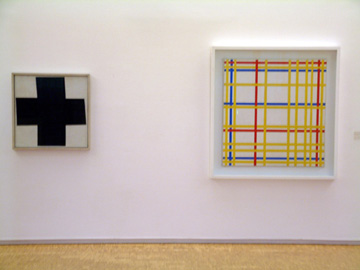
The National Museum of Modern Art is on the 3rd and 4th floors, where a set of the most complete history of Western modern art development in the 20th century is displayed, ranging from Fauvism to contemporary post-modern art, quite rich. Here are Mondrian's "New York City" geometric abstraction and Malevich's "Untitled" suprematist painting.