Address: 34, 36 Quai du Louvre 75001 Paris
Phone: 01 40 20 50 50, 01 40 20 51 51, 01 40 20 53 17
Metro: Line 1 Palais Royal Musee du Louvre or Louvre Rivoli station; Line 7 Palais Royal Musee du Louvre station
Opening hours: 9:00–18:00. Mondays: Richelieu wing open until 22:00 only. Wednesdays: entire museum open until 22:00. Closed: Tuesdays. (Free on the first Sunday of each month.)
Visit duration: approx. 3 hours. Website: The Louvre Museum www.louvre.fr
Preface
Although human civilization rises and falls with the vicissitudes of various eras, it continuously shifts its leadership position in its unique way. Thus, while Western civilization was still in a primitive state, Asian and African civilizations such as those of China, India, Egypt, Babylon, and Persia, as well as the Inca civilization of South America, had already experienced millennia of rise and decline in the history of human civilization. In the evolution of human civilization, we can see that every era and every region projected its own human imagery into the art of their lives. Today, the rich collections of the Louvre Museum throughout the ages represent the most complete display of the process of human civilization's evolution.
The Origin of the Louvre and the Louvre Museum:
The Louvre in Paris was built by Philip Augustus in 1180 as a castle to defend against Normans and Englishmen along the Seine River, which is today’s square courtyard of the Louvre. By the fourteenth century, Charles V settled there (1364–1380), making it his palace and adding walls and building the famous library. However, after Charles V’s death, it was not until 1545 that Francis I commissioned the renowned architect Pierre Lescot for renovation and expansion, with sculptor Jean Goujon responsible for decoration, giving the palace a style half Gothic, half Renaissance. Under Henry II, Lescot continued to direct the palace expansion. After Henry II died unexpectedly, his widow Catherine commissioned architect Philibert de l'Orme in 1563 to carefully build the Tuileries Palace on the old city wall. Shortly thereafter, due to de l'Orme’s death, the project was interrupted. In 1594, Henry IV added the Pavilion de Flore, connecting the Tuileries Palace and the Louvre, thus completing the Louvre.
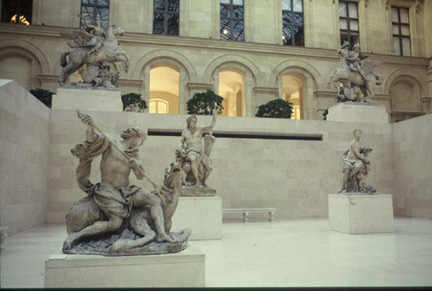
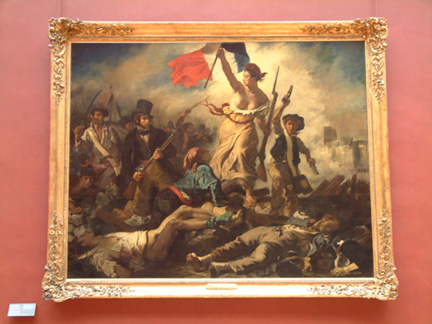
Starting in 1643, under Louis XIII, the square courtyard underwent expansion, completed under Louis XIV. Because it was decorated with numerous sculptures, it became the most striking building in the Louvre architectural complex, and the colonnade by Claude Perrault was completed in 1667. In 1682, Louis XIV moved the French government to the Versailles Palace near Paris, and the magnificent Louvre was actually "vacant for rent." By 1750, people even considered demolishing the Louvre. During the French Social Revolution, specifically on October 6, 1789, under petitions from the people of Paris, the royal family was forced to return to the Louvre. But less than three years later, the royal family fled entirely on June 20, 1791, and the Louvre was occupied by the people.
After the turbulent years of the French Social Revolution, it was not until Napoleon’s era in 1800 that the Louvre was renovated again. With the strong planning of two renowned architects Percier and Fontaine, the square courtyard was completed, the interior palace was renovated, and construction began on the north wing gallery along Rue de Rivoli. By 1852, Napoleon III commissioned Visconti to plan the Louvre as a grand palace and museum. It opened on August 14, 1857, marking the completion of the overall renovation and construction. However, in May 1871, the Tuileries Palace was burned down by rioters, and it was not until the Third Republic that Lefuel was commissioned to repair the Pavilion de Flore and the Marson wing of the Louvre’s north and south sides, creating the landscape of the Louvre today.
The Grand Louvre:
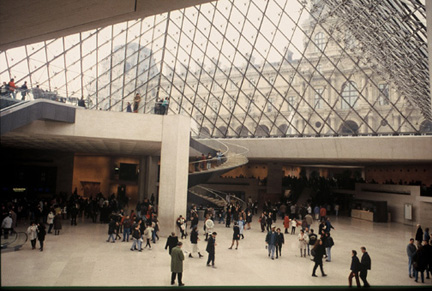
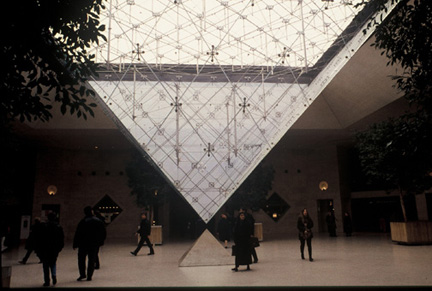
Due to the Louvre Museum’s rich collections, there has always been a lack of sufficient exhibition space. Additionally, the entrances and exits of the old Louvre Museum were too small, the visitor routes were overly complex like a maze, and issues such as six to seven million pilgrims annually, parking, and open spaces arose. Therefore, former President Mitterrand decided in 1981 to launch the Grand Louvre project, relocating the Ministry of Finance from the Pavilion de Flore. That same year, he accepted the construction plan by the internationally renowned Chinese-American architect I.M. Pei, beginning renovation works. Finally, in 1989, on the bicentennial anniversary of the French Social Revolution, the Grand Louvre opened. A spectacular large glass pyramid was newly built in the center of the Napoleon III courtyard, becoming the symbol and main entrance/reception space of the future Grand Louvre. Two smaller transparent pyramids on either side followed; the left Richelieu exhibition hall was completed and officially opened in 1993. The entire Grand Louvre renovation project was fully completed in 1997 (including the Tuileries Garden and underground parking, etc.).
After 19 years of planning and reconstruction, the Grand Louvre expanded exhibition space by nearly 30,000 square meters. As symbolic as the Grand Louvre itself is the glass pyramid at the entrance/exit of the Louvre Museum. It is neither a building nor a foreground; it completely preserves the landscape of the Louvre Museum, thus becoming the symbol of the Grand Louvre. This glass pyramid is 21.6 meters high, 35 meters wide, and weighs a total of 180 tons (86 tons of glass and 94 tons of stainless steel). It has become a tourist attraction in Paris and one of the most representative buildings of the twentieth century. Whenever the lights come on, it sparkles like a brilliant diamond in the City of Light.
Sources of the Grand Louvre Museum’s Collections:
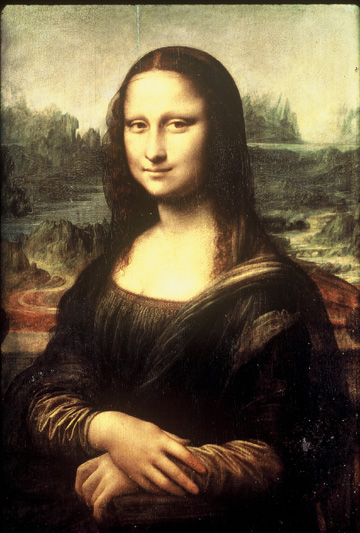
Through Charles V’s rich library collection, Francis I began collecting various artworks in his palace, including over ten works by Renaissance masters (Titian, Raphael, Da Vinci, etc.) and some Italian antiques. By Louis XIII, the King’s Gallery held over two hundred paintings. When Louis XIV died, the palace was decorated with more than 2,500 paintings, a considerable scale. At this time, the Louvre had become a regular exhibition venue for the Academy’s paintings and sculptures.
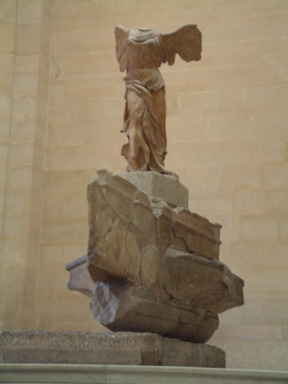
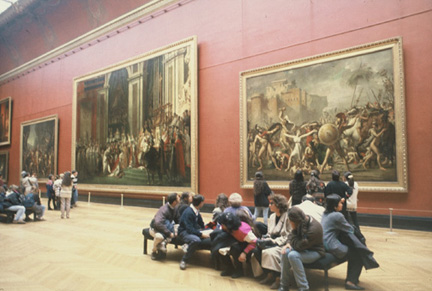
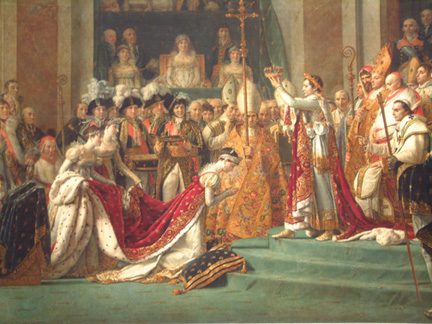
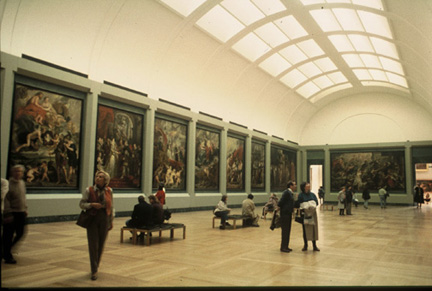
During Louis XV’s reign, consideration was given to converting the Louvre into a museum. Ultimately, on August 10, 1793, during the French Social Revolution, the National Convention officially opened the collections of the Louvre’s Great Gallery, marking the origin of the Louvre Museum. Since then, its collections have continuously increased, especially under Napoleon I, when the Louvre Museum became the place with the richest art collections in the world because he constantly plundered artworks from conquered countries. Thus, the Louvre Museum possesses an astonishing number of collections, including artworks from ancient Egypt, Persia, Iran, Greece, Rome, Europe, and other regions. From the Middle Ages to the mid-nineteenth century, all artistic works—including paintings, sculptures, drawings, ceramics, tapestries, bronzes, porcelain, decorations, furniture, and royal curiosities—are included in the collections. According to the museum’s collection catalog, the number of works is nearly 400,000.
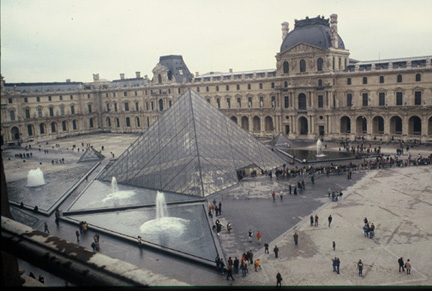
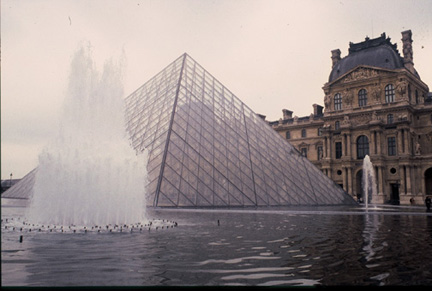
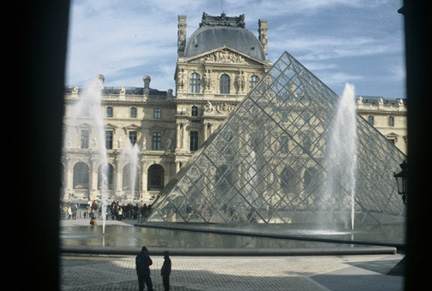
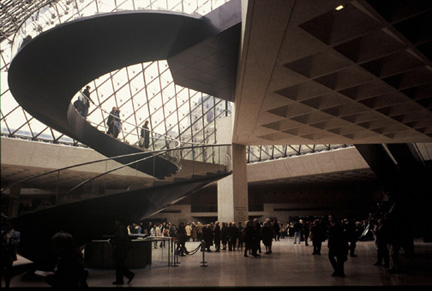
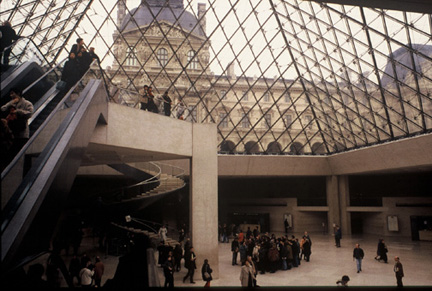
Below the pyramid is the convergence area for visiting the museum, leading to three major exhibition halls: the Richelieu Wing (Aile Richelieu), the Denon Wing (Aile Denon), the Sully Wing (Aile Sully), as well as places for ticketing, dining, and buying books.