Address: 14 Rue de la Rochefoucauld 75009 Paris
Phone: 01 48 74 38 50
Metro: Line 12 Trinite
Opening hours: 11:00–17:15
Closed: Every Wednesday
Visit duration: About 90 minutes
Website: Moreau Museum www.musee-moreau.fr
Characteristics of Moreau’s Painting
Gustave Moreau (1826–1898) was one of the most representative painters of 19th-century French Symbolism. His works possess a strong literary quality, akin to poetry. Influenced early on by Delacroix and Chasseriau, he studied classical art in Italy in 1857 and completed his training in plastic arts two years later before returning to France. In 1864, he exhibited Oedipus and the Sphinx, based on Greek mythology, at the Salon. The exhibition sparked fierce debate but also demonstrated his increasingly mature personal style and exceptional artistic talent. Five years later, Moreau ceased exhibiting at the Salon and focused entirely on his artistic creation.
The Surrealist Breton recalled the poet Mallarmé’s view of Moreau’s work: “This painting is fascinating; he praised these vivid unreals, born from the ignorance and perversity of ancient myths and the power of their confusing, ambiguous images.” Breton then paid highest tribute to Moreau, saying, “When I visited the Moreau Museum at age seventeen, it made me love it for life.”
Origin of the Museum
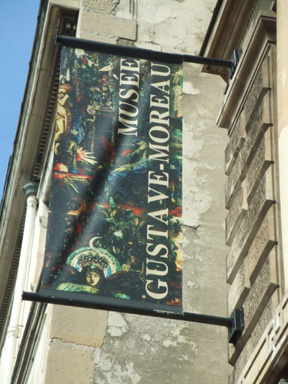
Located near the Trinity Church, the Moreau Museum is an 18th-century building that served as Moreau’s home and workplace throughout his life. In his later years, he expanded his studio to serve as his future personal museum. In his will dated September 10, 1897, he wrote: “I bequeath my home and my creations from nearly 50 years (paintings, drawings, watercolors) and personal memorabilia, etc., as a personal museum, just as they were collected in my home during my lifetime... I hope these works will be preserved permanently without being dispersed; this will be my greatest wish.” He passed away on April 18 of the following year. The government quickly established the Moreau Museum in accordance with his wishes to honor the outstanding artist.
Collection and Appreciation of Masterpieces
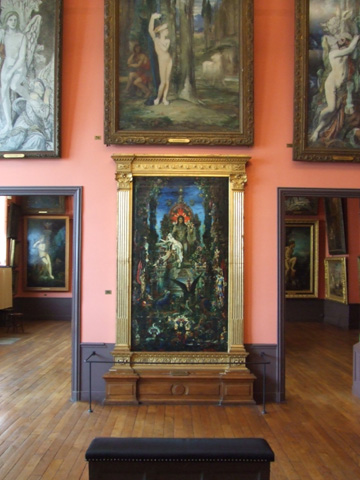
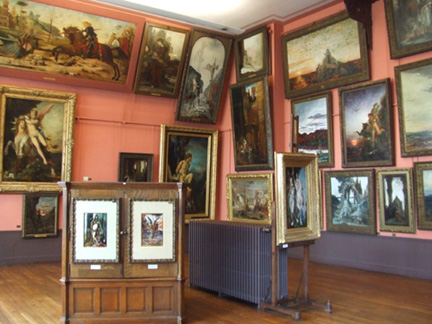
Designed by Henri Rupp between 1898 and 1899, the museum has remained virtually unchanged to this day, preserving the characteristic atmosphere of a studio-museum filled with Moreau’s creative and living environment. The museum holds approximately 14,000 works from his lifetime, currently displaying about 1,200 oil paintings and watercolors, and 5,000 drawings.
Second Floor – Home Memorial Hall: Upon entering, you find the painter’s former living room, its walls covered with numerous early sketches. An old table displays newspapers favored by 19th-century painters. The intact sofa and various personal mementos and treasures remain. Next is a beautiful small dining room, followed by a comfortable bedroom hung with small works, and finally, a private archive room.
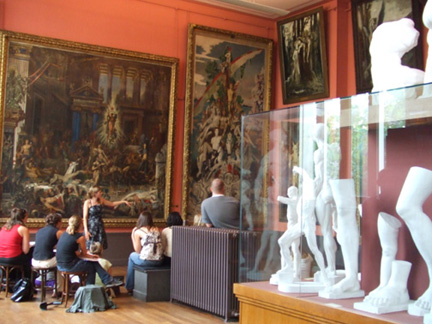
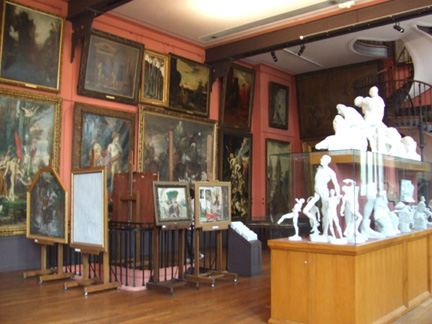
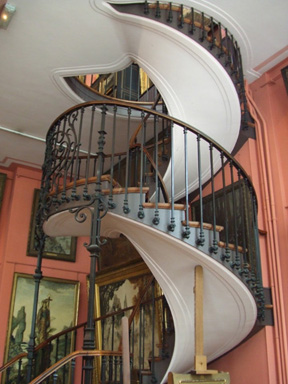
Third Floor – Large Studio: The walls are almost entirely covered with large paintings. Centered around the magnificent canvas The Lustful Ones (Les Luxuriens), inspired by Couture’s The Fallen Roman. Two other impressive large drawings stand out: Oedipus and the Sphinx (1864), his first famous sketch depicting a battle between genders, and The Poet Bessan (1890), showing the poet riding a horse that transforms into a unicorn. Three points are noteworthy: most works are unfinished; all draw on mythological themes; and the compositions are highly complex and mysteriously bizarre. A generous circular staircase leads to the fourth-floor exhibition rooms.
Fourth Floor – Large Gallery: Divided into two exhibition rooms of different sizes, both walls are densely hung with paintings. The smaller room features imaginative mythological works such as Jupiter and Semele, alongside the unfinished Alexander’s Triumph, showcasing his most dramatic mythological world. In the larger room, masterpieces like Tyrtaeus Singing in War, Return of the Argonauts, Daughters of Tiberius, and Moses Seeing the Promised Land fill the space with magical illusions and poetic atmosphere.